08
July 2026
Markets pare back Fed rate outlook after oil slide

Adriaan Pask
Chief Investment Officer, PSG Wealth
The first week of July 2026 marked a subtle but meaningful shift in market expectations surrounding US monetary policy. Although the Federal Reserve (Fed) maintained a cautious stance at its June meeting, subsequent developments, notably softer labour market data, easing inflation expectations and a sharp decline in oil prices, have prompted investors to question whether policymakers may ultimately need to keep interest rates elevated for as long as previously anticipated.
When finalising its projections, the Fed left interest rates unchanged, while materially revising its inflation forecasts higher. Those projections, however, were compiled before oil prices retreated sharply. Brent crude traded around $100 per barrel before the market had settled near $80. By the end of last week, Brent had fallen to roughly $72 per barrel as progress in indirect US-Iran negotiations and the expected reopening of the Strait of Hormuz eased concerns over global energy supplies.
The decline in energy prices has improved the near-term inflation outlook. Lower oil prices reduce fuel, transport and production costs across the global economy, easing one of the key upside risks that had weighed on markets only weeks earlier. This has led investors to increasingly view the Fed’s June projections as reflecting a macroeconomic backdrop that is already shifting.
Those global developments, together with the easing of geopolitical tensions and the prospect of reopening the Strait of Hormuz, have also eased domestic inflation pressures. Locally, fuel prices were cut on 1 July 2026, and markets expect a further sizeable reduction next month, reinforcing the view that headline inflation may moderate in the coming months.
June’s US employment report reinforced this reassessment. Non-farm payrolls increased by just 57 000 jobs, significantly below consensus, while payroll estimates for April and May were revised lower. Although the unemployment rate unexpectedly declined to 4.20%, this partly reflected a contraction in labour force participation rather than stronger hiring activity. The softer jobs data led investors to scale back expectations of further interest rate irises this year.
Fed Chair Kevin Warsh, speaking at the annual Forum on Central Banking in Sintra, said that easing inflation risks had not changed the Fed’s overarching aim of returning inflation to 2%. He stressed that restoring price stability remains the central bank’s chief priority and that its policy approach will adapt as economic data warrant. He also underlined the Fed’s independence from political influence and said the bank would no longer rely on conventional forward guidance about future rate moves. In June the Fed held interest rates steady but signalled that some policymakers remain open to further tightening later in the year as inflation continues to run above target.
Although some uncertainty surrounding inflation remains, the combination of lower oil prices, cooling inflation expectations and weaker employment data has shifted market focus away from additional policy tightening. Whether this ultimately proves sufficient to keep interest rates unchanged will depend on how durable these trends prove to be over the coming months. For now, however, markets appear increasingly convinced that the inflation risks confronting policymakers at the June meeting have already begun to moderate.
Brent crude oil price development over the past 30 days
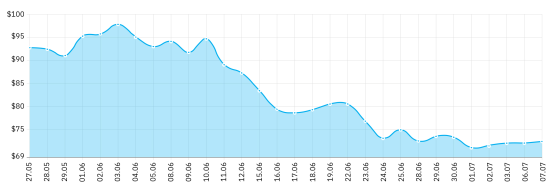 Source : BrentWatch.com
Bottom Line
While the Fed is still likely to keep interest rates unchanged for the remainder of this year, markets are expected to place greater weight on the recent decline in oil prices and incoming economic data than on the backward-looking minutes. A weaker inflation outlook should ease upward pressure on US bond yields, allowing the US dollar’s gradual weakening trend to continue. This would, in turn, provide a supportive backdrop for the rand and other emerging market currencies, provided global risk sentiment remains broadly constructive.
Macroeconomics in brief
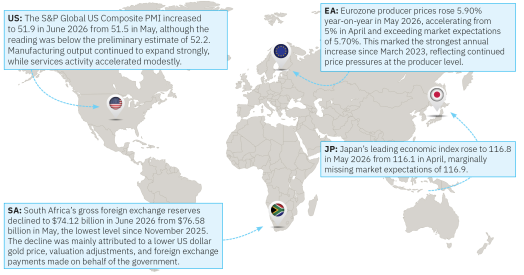
Key Market Indicators
Select a tab to navigate
- Loading data...
- Loading data...
- Loading data...