06
May 2026
US inflation accelerates as energy shock reshapes growth dynamics

Adriaan Pask
Chief Investment Officer, PSG Wealth
US inflation accelerated in March 2026, according to data recently released, with the Federal Reserve’s (Fed) preferred Personal Consumption Expenditures (PCE) price index rising 0.70% month-on-month and 3.50% year-on-year, its fastest pace since May 2023.
The increase was largely driven by sharply higher gasoline prices amid ongoing disruptions to energy supply linked to the Middle East conflict. Prices remained high throughout April, and the effect is slowly making its way through other goods and services in the economy, according to analysts. Core inflation, which excludes food and energy, rose 0.30% on the month and 3.20% annually, up from 3% previously.
Inflation remains above the Fed’s 2% target, with policymakers keeping interest rates unchanged as elevated energy costs and broader geopolitical uncertainty and the war’s impact on global trade continue to cloud the outlook. Chair Jerome Powell noted that the current policy stance is well-positioned to allow time for further assessment, as developments add to inflation risks.
Despite these pressures, economic activity showed resilience. The US economy expanded at an annualised rate of around 2% in 1Q26, while jobless claims remained near multi-decade lows. Wage growth also strengthened to 3.40% over the same period, offering some support to household income. However, underlying consumer dynamics are weakening. Consumer spending rose 0.90% in March but only 0.20% in real terms, with energy-related costs accounting for a significant share of the increase. Disposable income declined slightly after adjusting for inflation, while the personal saving rate fell to 3.60%, its lowest level in four years.
Looking ahead, growth composition is expected to shift. Consumer spending is likely to moderate as higher prices weigh on purchasing power, with increased reliance on government outlays and business investment.
Defence‑related spending is expected to rise as the conflict persists, providing a tailwind to public demand. Business investment, meanwhile, is being sustained by a surge in outlays linked to artificial intelligence infrastructure, including data centres, cloud capacity and information‑processing equipment. However, a sizeable share of the associated hardware is imported, which means AI‑related investment lifts business activity more than headline growth, as higher imports partially offset the contribution to GDP.
The Iran‑related war has disrupted oil and gas flows, slowed shipping in the Persian Gulf and the Strait of Hormuz, and tightened supply of fertiliser and other critical commodities. Analysts expect energy prices to stay elevated even if a resolution emerges, given the damage to production and refining infrastructure, and food prices are also likely to rise as these disruptions work through global supply chains. While tax refunds and wealth gains from stocks and housing have helped cushion households, there is growing concern that prolonged inflation could erode real incomes and further weaken consumer‑driven growth over the rest of 2026.
US economic growth seen rebounding
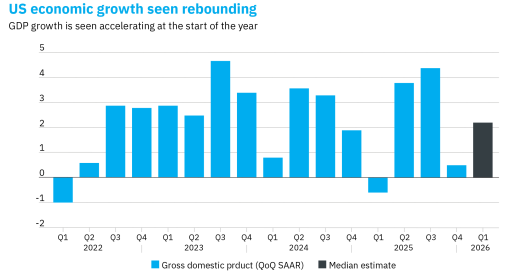 Source : Bureau of Economic Analysis, Bloomberg Survey
Bottom Line
US growth is moderating – evident in a softer labour market and weaker consumer spending, alongside a multi-year easing in leading indicators – while inflation is being pushed higher by tariffs and, more recently, energy shocks linked to the Iran war. This leaves policymakers facing a classic dilemma: cost-push pressures risk lifting inflation expectations in the near term even as growth weakens, raising the question of whether to tighten now and risk a sharper slowdown, or look through the shock and ease more aggressively later.
Macroeconomics in brief
Key Market Indicators
Select a tab to navigate
- Loading data...
- Loading data...
- Loading data...