03
June 2026
South Africa gains momentum on stronger fiscal and policy credibility

Adriaan Pask
Chief Investment Officer, PSG Wealth
South Africa’s macroeconomic backdrop is increasingly characterised by improving policy credibility and greater financial stability, even as global conditions remain volatile.
The central message from economists and policymakers is not that risks have disappeared, but that South Africa is now operating from a materially stronger base than in previous global shock periods. In contrast to the Covid-era stress period—when fiscal deficits widened sharply and debt sustainability concerns escalated—today’s environment reflects more controlled public finances and a clearer policy anchor.
Government finances have shown measurable improvement, supported by tighter expenditure management and stronger than-expected revenue collection. This has reinforced the fiscal consolidation narrative, even in a low-growth environment, and reduced concerns around near-term debt instability. A key development is the emerging stabilisation in the debt-to-GDP trajectory. While debt levels remain elevated, the upward pressure seen in previous years has eased, with the ratio increasingly viewed as plateauing rather than continuing on an unsustainable path. This shift is central to improved sovereign risk perceptions.
Importantly, South Africa is also seeing early but tangible progress in structural constraints that have weighed on growth for years. Energy availability has improved relative to prior periods, with a marked reduction in the intensity and frequency of load-shedding, while incremental reforms in logistics and state-owned enterprises are beginning to support greater operational stability. Although progress remains uneven and execution risk persists, the direction of travel is increasingly seen as supportive of medium-term stability.
This improvement is also reflected in the composition of the fiscal position. South Africa has increasingly generated a primary budget surplus, meaning non-interest expenditure is covered by revenue. This stabilises debt dynamics by ensuring new borrowing is driven largely by interest costs rather than day-to-day spending pressures.
Inflation dynamics have similarly supported the credibility narrative. Price pressures have remained relatively contained and broadly anchored around the mid-target range, especially compared to peer emerging markets experiencing more persistent inflation shocks. This has enabled the South African Reserve Bank to maintain a disciplined and forward-looking policy stance without destabilising financial conditions.
These improvements are reflected in sovereign risk assessments. Both Moody’s and S&P Global maintain positive outlooks on South Africa’s credit profile, signalling conditional confidence in the fiscal trajectory. Market focus is increasingly shifting from stabilisation to potential upgrades. Moody’s positioning is broadly consistent with a possible upgrade over the next 12 to 18 months, provided fiscal consolidation and reform momentum continue. S&P Global, the first of the major agencies to assign a positive outlook, is in some cases seen as potentially moving earlier, particularly after key fiscal and political milestones expected in 2026.
Across both agencies, the conditions for improvement remain consistent: sustained fiscal discipline, continued structural reform progress, and a firm commitment by the Reserve Bank to anchoring inflation. Any slippage in these areas would likely delay or reverse progress.
Debt stabilisation remains a key focus. Rating agencies continue to monitor the government’s ability to stabilise the debt-to GDP ratio, limit additional borrowing, and contain debt-service costs over time. The durability of primary surpluses is central to this outlook. For investors, the implications are direct: higher sovereign credit ratings would typically support lower borrowing costs, a reduced risk premium, improved capital inflows, and a more supportive backdrop for South African assets.
Financial markets have already begun to reflect this shift. Despite global volatility, South African asset classes have remained resilient. The rand has been broadly stable, local bonds have continued to attract demand, and equities have held up relatively well. This resilience has been reinforced by ongoing portfolio inflows into fixed income during risk-off periods, reflecting the continued appeal of yield relative to perceived risk. While commodity support has helped, pricing increasingly reflects a stronger domestic credibility premium.
Monetary policy has reinforced this narrative. The South African Reserve Bank’s recent rate hike—its first since 2023—was a pre-emptive move to contain inflation risks arising from global supply shocks. Although higher rates weigh on growth in the short term, the decision is widely viewed as consistent with a framework prioritising inflation anchoring and long-term stability over cyclical support.
Inflation remains contained but is expected to sit slightly above target in the near term due to external cost pressures. The Bank’s willingness to act early is aimed at preventing second round effects from becoming entrenched.
A key structural positive remains the Reserve Bank’s independence and credibility, which continues to anchor confidence in the currency, bond market, and broader policy framework.
Against this backdrop, the cumulative impact of reforms over recent years is becoming more visible. While progress has been gradual, improvements in electricity supply, governance discipline, and parts of the logistics network are easing key constraints on growth. The binding constraint remains execution consistency rather than policy direction.
For investors and advisors, the key development is a gradual re-rating of South Africa’s risk profile from highly fragile to cautiously stabilising. Improved fiscal discipline, credible monetary policy, strengthening energy stability, and early stage structural reform are collectively supporting more durable confidence. The forward-looking risk remains execution. Sustaining fiscal discipline, maintaining policy coherence, and accelerating reform delivery will determine whether improved sentiment translates into a sustained uplift in growth and asset valuations.
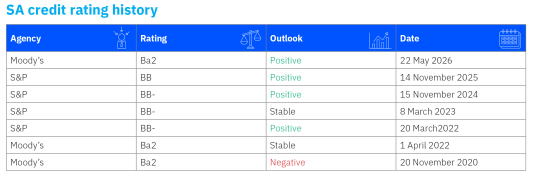 Source : Trading Economics
Bottom Line
South Africa’s story is gradually shifting from one of vulnerability to one of resilience. The combination of stronger public finances, improving institutional credibility and ongoing reform progress suggests that local assets are entering this period of global uncertainty from a firmer footing than many appreciate. Maintaining that momentum will be crucial, but the direction of travel is becoming increasingly difficult to ignore.
Macroeconomics in brief
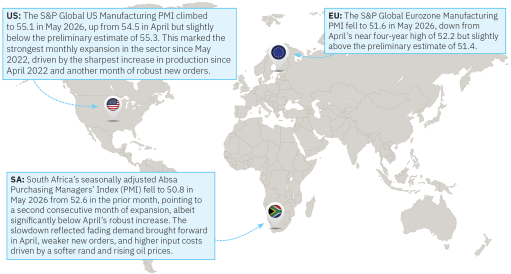
Key Market Indicators
Select a tab to navigate
- Loading data...
- Loading data...
- Loading data...