22
April 2026
SARB signals prolonged policy caution as global energy shock delays easing cycle

Adriaan Pask
Chief Investment Officer, PSG Wealth
The South African Reserve Bank (SARB) has indicated that near-term interest rate cuts are unlikely, as elevated uncertainty from the Middle East conflict continues to complicate the inflation and growth outlook. Governor Lesetja Kganyago told Reuters on the sidelines of the IMF–World Bank Spring Meetings that volatile movements in oil and fertiliser prices are limiting policy flexibility and reinforcing a cautious stance.
He noted that the Bank has shifted further toward scenariobased analysis rather than frequent forecast adjustments, reflecting the unpredictable nature of recent commodity price swings. The SARB’s adverse scenario assumes oil prices averaging around $94 per barrel and a potential 20% depreciation in the rand, underscoring the sensitivity of the outlook to external shocks.
Kganyago said the conflict is broadly negative for growth while also adding pressure to inflation, effectively delaying expectations of monetary easing across emerging markets (EM). This aligns with a broader shift in EM policy cycles, where anticipated rate-cut paths have been pushed out amid renewed global supply-side risks.
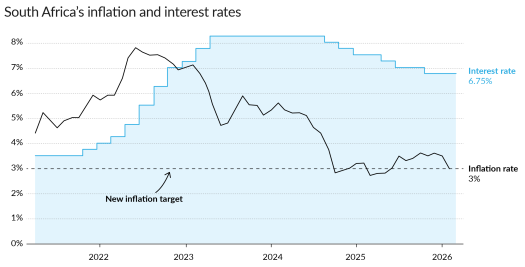
The SARB recently kept the repo rate unchanged at 6.75%, citing the need for continued caution as higher energy costs feed through the economy. While South Africa is not currently facing fuel shortages, Kganyago highlighted that the impact on agriculture, particularly fertiliser usage, will only become clearer during the upcoming planting season.
Overall, the Bank emphasised that elevated uncertainty has become the defining feature of the policy environment, reinforcing a more data-dependent and cautious monetary stance.
South Africa’s inflation and interest rates
 Source : Bloomberg
Bottom Line
Before the war, the outlook supported around three 25 basis point rate cuts this year. If the conflict had been short-lived, those cuts would likely have been delayed rather than derailed, still materialising later in 2026. However, the war has lasted longer, and supply disruptions have been more severe, meaning oil prices will take longer to normalise toward ~$65/bbl. 2024 2025 2026 Interest rate 6.75% Inflation rate 3% As a result, the risk of a rate hike in May has increased materially, aimed at containing inflation expectations and second-round effects. That said, we do not expect a hiking cycle — with the conflict likely nearing resolution, a single hike followed by renewed cuts starting later this year remains the most plausible path.
Macroeconomics in brief
Key Market Indicators
Select a tab to navigate
- Loading data...
- Loading data...
- Loading data...