18
June 2026
Middle East de-escalation eases pressure on global growth and inflation

Adriaan Pask
Chief Investment Officer, PSG Wealth
Recent developments in the Middle East have improved market sentiment, shifting the narrative from escalating conflict to cautious optimism.
Earlier this month, the World Bank lowered its 2026 global growth forecast to 2.50%, citing the economic fallout from the conflict in the Middle East. While global growth remained resilient at 2.90% in 2025, the war disrupted energy markets, reignited inflation concerns and created fresh uncertainty for businesses and investors across the globe.
The Strait of Hormuz has been central to these concerns. As one of the world’s most important energy shipping routes, disruptions to trade through the strait pushed oil prices sharply higher, placing renewed pressure on inflation and raising concerns about global supply chains and food costs through higher fertiliser prices.
The World Bank lowered growth forecasts for two-thirds of countries and warned that prolonged energy disruptions could have a far more severe impact on the global economy. Its baseline outlook assumes an average Brent crude oil price of $94 per barrel this year, with global inflation expected to reach 4%. However, if energy supply disruptions were to persist and spill over into financial markets, global growth could slow to as little as 1.30%.
Against this backdrop, markets have welcomed the announcement of an agreement between the US and Iran aimed at reopening the Strait of Hormuz and easing tensions in the region. US President Donald Trump has said the agreement is “all signed”, with the strait expected to be fully reopened once a formal signing ceremony takes place later this week.
The prospect of normalising energy supplies has already improved investor sentiment. Oil prices have fallen sharply from their recent highs as geopolitical risk premiums have unwound, while equity markets have rallied on expectations that the agreement could limit further damage to global growth. Brent crude oil has retreated to around $80 per barrel, well below the World Bank’s baseline assumption of $94 per barrel for the year.
A sustained decline in energy prices could provide relief for the global economy by easing inflationary pressures and reducing pressure on central banks to keep interest rates elevated for longer. Lower energy costs would also support consumer spending and help alleviate some of the supply chain pressures that emerged during the conflict.
However, several aspects of the agreement still need to be finalised, including the implementation of commitments by all parties involved. While tensions in the region have eased, geopolitical uncertainty has not disappeared entirely, meaning markets are likely to remain sensitive to further developments over the coming weeks.
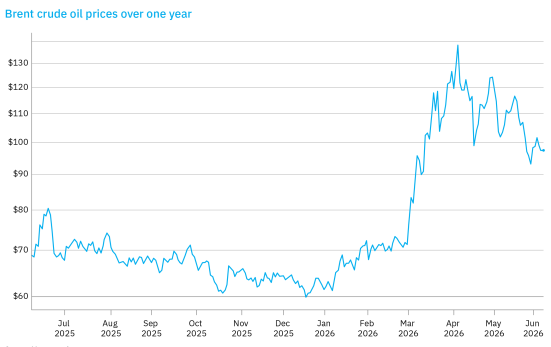 Source : Macrotrends
Bottom Line
The Middle East conflict has weighed on global growth prospects and intensified inflation risks through higher oil prices. However, the recent US–Iran agreement and the reopening of the Strait of Hormuz mark a meaningful deescalation, easing pressure on energy markets. While implementation risks remain, a sustained easing in energy prices would be supportive for both global growth and inflation, and financial markets are increasingly pricing in a more constructive outlook.
Macroeconomics in brief
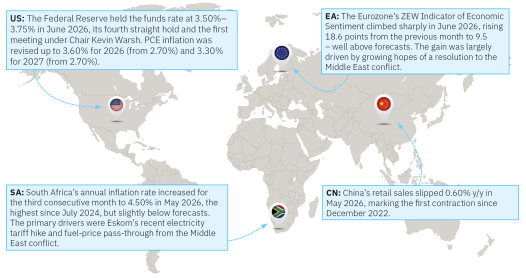
Key Market Indicators
Select a tab to navigate
- Loading data...
- Loading data...
- Loading data...