13
May 2026
South Africa’s policy outlook steadies amid global volatility

Adriaan Pask
Chief Investment Officer, PSG Wealth
At the PSG Financial Services conference held in Sun City last week, South African Reserve Bank (SARB) Governor Lesetja Kganyago and National Treasury Director-General Duncan Pieterse set out a broadly aligned view of South Africa’s economy against a difficult global backdrop.
Kganyago pointed to an unstable global environment driven mainly by geopolitical conflict and high government debt in major economies. These pressures are feeding through into higher food and fuel prices, which continue to drive inflation in emerging markets and reduce household buying power.
He stressed that while the SARB cannot control these global shocks, it must ensure inflation returns to target once they ease. This makes monetary policy more difficult because inflation driven by supply shocks creates a tougher balance between supporting growth and keeping inflation under control. Interest rate decisions therefore, depend on getting the timing right. Acting too early could slow the economy more than necessary, while acting too late risks allowing inflation to stay higher for longer. Kganyago noted that policy flexibility is important in managing this balance.
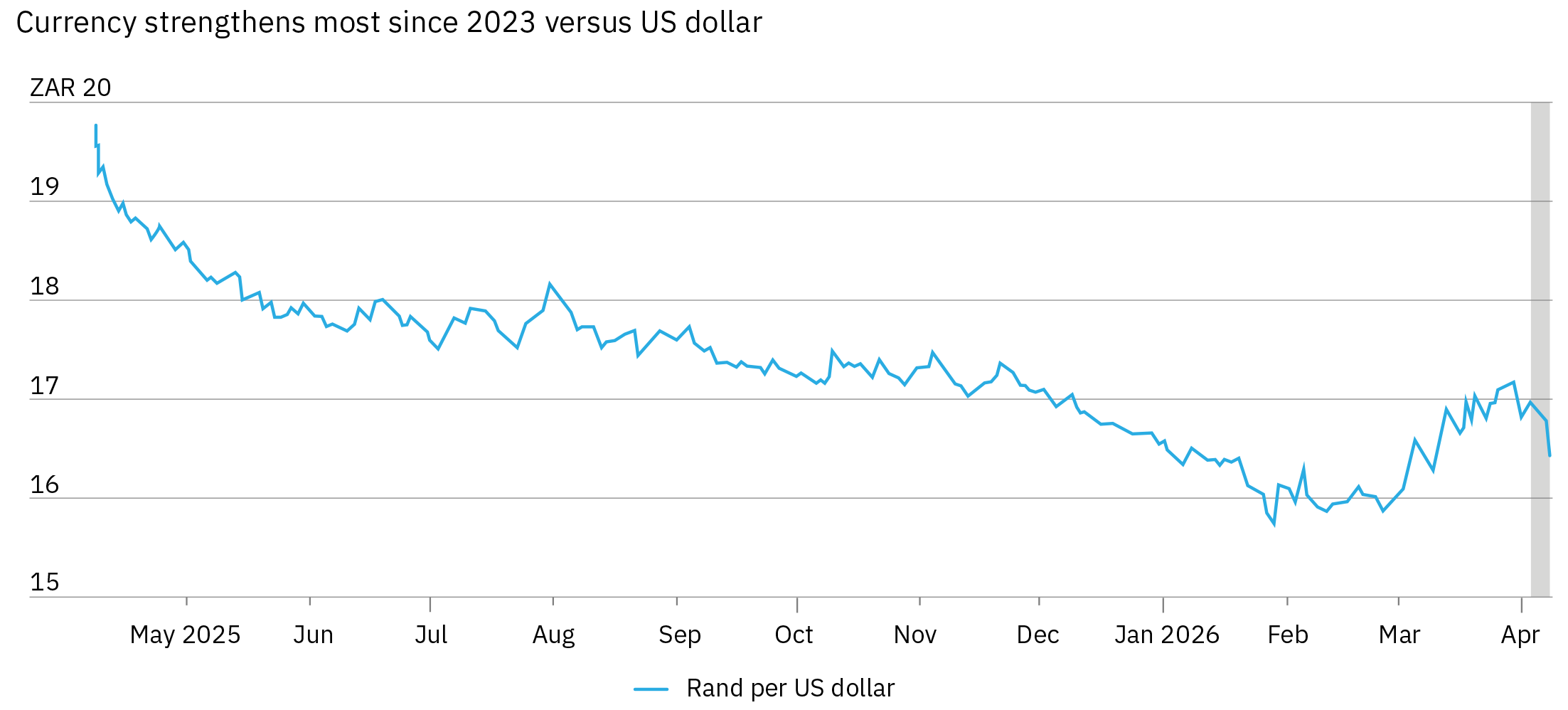
Financial markets have also reflected this uncertainty. The rand and other emerging-market currencies initially weakened during the Iran conflict but later recovered. This suggests improved investor confidence and a gradual shift away from heavy reliance on the US dollar. The rand is now back to levels seen before the shock and is broadly in line with other emerging-market currencies. However, the US dollar remains the world’s dominant currency, accounting for about 57% of global foreign exchange reserves. Against this global backdrop, improving domestic policy credibility has also started to support investor sentiment in South Africa. After years of rising debt and credit rating downgrades, the country is now in a phase of fiscal consolidation, with tighter spending control and more consistent policy beginning to bolster market confidence. Even so, structural reform remains important, especially in a weaker global growth environment where local policy decisions matter more for investment and growth outcomes.
Alongside this, Pieterse highlighted South Africa’s improving fiscal position and stronger engagement with ratings agencies, supported by growing optimism from Moody’s and a more positive medium-term credit outlook.
Moody’s expects government debt to peak at around 86.80% of GDP in 2025 before gradually falling to 84.90% by 2028. This improvement is expected to come from tighter spending control and continued reforms. The agency kept South Africa’s Ba2 stable rating, pointing to better revenue collection, stronger spending discipline, and more stable funding conditions, although high debt remains a constraint.
It also warned that global shocks such as the Iran conflict could temporarily slow growth by 20 to 50 basis points in 2026–2027 through higher commodity and transport costs. Even so, growth is still expected to recover to around 2% by 2028, supported by reforms in energy, logistics, and water systems, as well as stronger control of inflation.
Overall, fiscal policy is increasingly seen not just as a way to stabilise the economy, but also as a tool to support growth by encouraging more private sector investment in infrastructure.
US economic growth seen rebounding
 Source : Bureau of Economic Analysis, Bloomberg Survey
Bottom Line
Kganyago highlighted the trade-off between acting early on fuel-driven inflation or risking a longer tightening cycle, with a bias toward a rate cut at the 28 May MPC meeting. Pieterse reinforced improving fiscal credibility, stronger ratings sentiment, and a gradual shift toward using fiscal discipline to support infrastructure-led growth, supporting a more stable medium-term outlook for South Africa.
Macroeconomics in brief
Key Market Indicators
Select a tab to navigate
- Loading data...
- Loading data...
- Loading data...