10
June 2026
Municipal delivery emerges as key test for South Africa’s growth outlook

Adriaan Pask
Chief Investment Officer, PSG Wealth
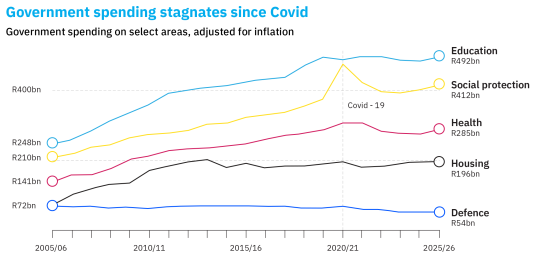
South Africa’s ability to sustain economic reform momentum and attract investment is increasingly shifting from fiscal repair towards delivery and execution at local government level. According to recent analysis by economists, government spending on key social services has largely stagnated in real terms since the Covid-19 pandemic, and there are growing concerns that expenditure is not keeping pace with population growth.
According to a statement released by the Institute for Economic Justice (IEJ), the 2026 Budget appears disconnected from the economic challenges faced by many South Africans. Fiscal consolidation has become a primary objective, rather than a means of supporting broader investment in infrastructure, public services and human development. Despite persistently high unemployment and its severe social consequences, job creation received only limited attention.
As South Africa approaches 2030, the target year of the National Development Plan (NDP), it still needs to focus and achieve several key objectives, including faster growth in real income per person, substantially lower unemployment and meaningful reductions in poverty and inequality.
Since the Covid‑19 shock, inflation-adjusted spending on health, education, housing, social protection and defence has either stabilised or declined in recent years. Health expenditure increased from the equivalent of R141 billion in 2005 to R306 billion in 2020 before falling to R274 billion in 2024 and recovering modestly to R285 billion in 2025. Education spending reached R492 billion in 2025, marginally above its 2019 peak, while housing expenditure remained broadly unchanged from levels reached more than a decade ago.
However, population growth has diluted the impact of these budgets. Health spending per person declined from the equivalent of R4 886 in 2019 to R4 523 in 2025, while research by the IEJ indicates that spending per learner is expected to decline over the next three years.
Some commentators argue that slower spending is an understandable response to elevated debt and the need for fiscal repair.
Johann Els, Chief Economist at PSG Financial Services, said slower government spending should not necessarily be viewed negatively given South Africa’s fiscal challenges and elevated debt levels. He noted that spending restraint has contributed to an improved fiscal position and a more constructive view of South Africa among investors. According to Els, the focus is increasingly shifting from fiscal repair towards whether the country can improve service delivery, infrastructure provision and implementation despite tighter budget constraints.
These themes featured prominently at the recent RMB Think Summit, where business leaders, political analysts and development financiers highlighted municipal performance as a critical determinant of South Africa’s growth prospects. Some bank chiefs attending the Summit said that South Africa needs an additional R750 billion to R1 trillion a year in infrastructure spending to boost growth and caution that capable municipalities are vital to turn that investment into concrete outcomes.
Speakers also highlighted the role of local government in maintaining roads, water networks, sanitation systems and electricity infrastructure, all of which influence business activity and investment decisions. Several panellists argued that policy reforms at national level will only translate into stronger economic outcomes if municipalities are able to implement projects effectively and provide reliable services.
Against this backdrop, November’s local government elections are increasingly being viewed as an important test of South Africa’s reform trajectory. Els noted that businesses, infrastructure and essential services ultimately operate at municipal level, making the ability to improve execution and governance a key consideration for investors assessing the country’s long-term growth potential.
With limited scope for significantly higher public spending, the focus is increasingly shifting towards spending efficiency, implementation capacity and creating an environment that supports stronger private-sector investment and growth.
 Source : GroundUp
Bottom Line
Fiscal discipline has helped place South Africa on a firmer footing than during previous periods of uncertainty, but tighter budgets inevitably increase the importance of effective implementation. The country’s growth prospects will therefore depend increasingly on the quality of infrastructure delivery and municipal governance rather than simply higher levels of public spending. The upcoming local government elections will provide an important indication of whether South Africa can build on recent reform momentum and unlock a more durable growth path.
Macroeconomics in brief
Key Market Indicators
Select a tab to navigate
- Loading data...
- Loading data...
- Loading data...