30
April 2026
Online Funds’ performance for the quarter ended 31 March 2026

Adriaan Pask
Chief Investment Officer, PSG Wealth

Domestic online funds performance and positioning
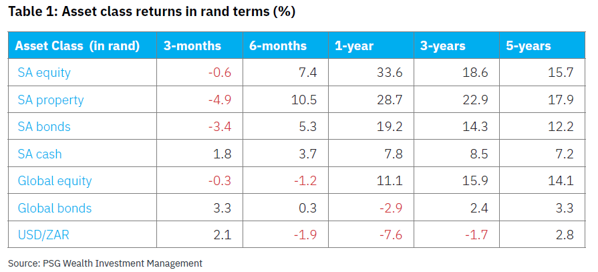
The first quarter of 2026 delivered a broadly mixed outcome. Fixed income was the standout asset class globally, with government and global bonds returning 2.20% and 2.30% respectively, while global cash delivered 4.25% as rate expectations shifted. Among equities, performance varied, with
UK equities leading developed markets at 4.80%, Japan gaining 4%, and emerging markets returning 3.10%. US equities declined 1.20% and European equities fell 2.30%. Global listed property recovered 3.50% over the quarter despite a weak March. Twelve-month figures reflected the strength of the prior year, with emerging market (EM) equities up 20.60%, UK equities 16.60%, and Japan 27.70%.
South African assets faced headwinds from rand weakness and domestic risk aversion over the period under review. The JSE All Share edged down 0.60% for the quarter, SA Listed Property fell 4.90%, and SA Bonds declined by 3.40%. Despite a challenging quarter for markets, all three retain substantial 12-month gains of 33.60%, 28.70%, and 19.20%, respectively. Multi-asset investors with global diversification were generally well-served this quarter, with fixed income providing meaningful support against equity volatility. The near-term outlook for SA assets and US equities warrants monitoring, while emerging markets appear supported by improving fundamentals.
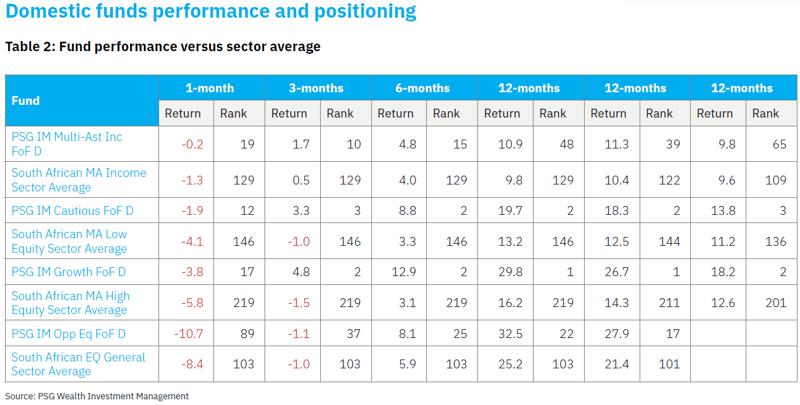
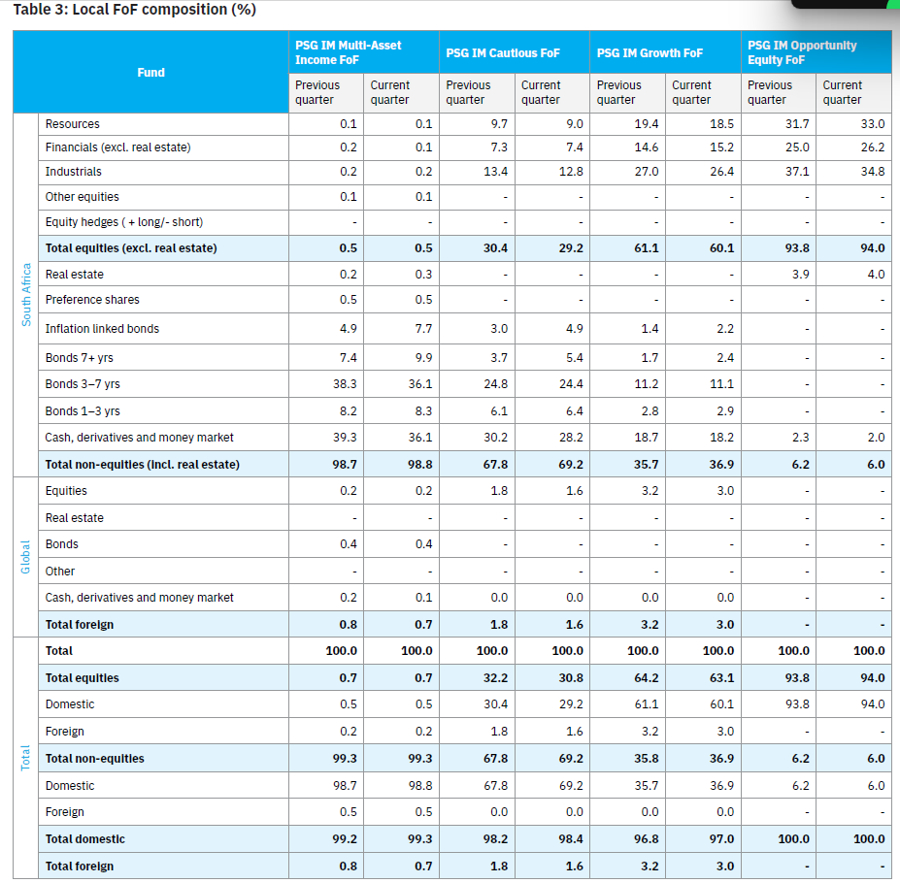
The multi-asset solutions generated alpha in 1Q26. All building blocks delivered positive absolute returns despite the March 2026 pullback, with equities as the primary driver in our solutions that have exposure to them. Quarter-on-quarter, our underlying managers in that building block trimmed exposure to industrials in favour of upweighting resources, reflecting their positive medium-term outlook on the sector.
The income building block also added returns on an absolute basis as the government bonds held provided stability. Our underlying managers in the income building block trimmed their allocation to the belly of the curve, adding duration selectively and maintaining the rest in dry powder.
At Funds of Funds (FoF) level, the aggregate effect of underlying manager activity in the Income FoF was a significant rotation out of cash and into longer-duration domestic bonds. Cash and money market holdings declined by 3.23%, with proceeds deploying into inflation-linked bonds and nominal bonds with maturities of seven years and longer. Managers trimmed shorter-dated three-to-seven-year bonds by2.17%, favouring duration extension over holding the belly of the yield curve. SA equity and global positioning saw only marginal net changes, with underlying manager movements leaving the FoF’s offshore exposure broadly unchanged.
In the Cautious FoF, the shifts in asset allocations were more moderate. Overall, cash allocations decreased with a corresponding increase in domestic duration, with inflation-linked bonds rising by 1.90% and longer-dated bond exposure by 1.70%. Exposure to SA Equities declined by 1.20% on a net basis, a reduction driven by our underlying equity managers trimming positions and market movement. The FoF’s overall domestic allocation remained broadly stable. Globally, our underlying managers trimmed equity exposure, with the FoF total foreign allocation declining accordingly.
In the Growth FoF, the net result of underlying manager decisions was a modest rotation from cash and shorter bonds toward longer-dated domestic fixed income assets. Inflation-linked bonds increased by 0.86% and longer-dated bonds by 0.77%, while cash fell by 0.47% and shorter bonds by 0.13%. SA equity allocations declined by 0.94% on a net basis. Global allocations saw a marginal reduction, resulting overall in a slight increase in total domestic exposure of 0.21% and a corresponding reduction in offshore.
The PSG IM Opportunity Equity FoF lagged its benchmark over the quarter by 14 basis points, on the back of a muted March in which domestic risk assets came under pressure. The fund nonetheless remains ahead of benchmark over 12 months and over all longer measurement periods. At a sector level, the underlying managers on balance trimmed industrials exposure, funding selective additions to resources and financials. No changes were made to fund composition over the quarter.
PSG IM Global Flexible Fund of Funds
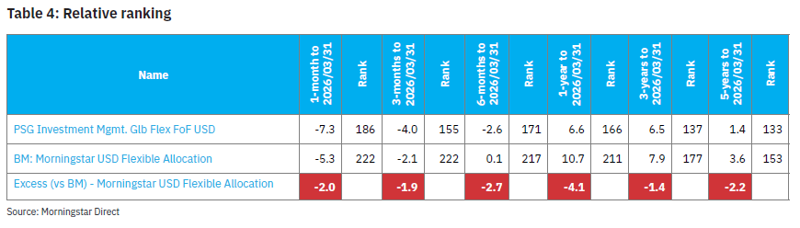
The Global Flexible FoFs faced a challenging quarter in relative terms, dropping 4% against the sector average of -2.10% (an underperformance of 1.90%). Two of the eight underlying managers outperformed the sector over the period, with PSG Global Flexible and Capital Group Capital Income Builder, which cushioned losses as markets closed the quarter in negative territory. On fund composition, we removed Veritas Global Real Return from the FoFs after completing a six-month qualitative monitoring period, initiated in July 2025. While part of the manager’s recent underperformance reflects cyclical headwinds for their quality style, our decision to disinvest was driven by a broader weakening of the investment thesis, including changes to the team and investment process, deteriorating attribution trends, and growing concerns around liquidity. The proceeds have been reallocated equally across the remaining underlying managers.