
04
January 2024
How a single grain of rice can turn into millions

Abrie Grobler CFA® Wealth Manager: Securities
When we think about artificial intelligence (AI), we typically think about extreme examples such as Arnold Schwarzenegger in The Terminator, Keanu Reeves in The Matrix or even Will Smith in I, Robot. All these movies have one emotion in common – fear. Most of us start feeling anxious when we talk about what artificial intelligence is, especially when thinking about what it could turn into. Instead of succumbing to our emotions and fears, let’s first try to gain a better understanding of the concept itself.

Feel free to reach out to PSG Wealth Manager Abrie Grobler directly.
McKinsey defines artificial intelligence as follows:
“A machine's ability to perform the cognitive functions we associate with human minds.”
Computers are no longer expected to only solve complex arithmetic problems or to work through enormous amounts of data and provide a bunch of statistics thereon. We are now at a level where computers can interpret data and are able to advise us on how to do things differently. Besides, this is no longer limited to numeric data only. Computers are now capable of writing speeches, poems or even screenplays.
However, AI is not necessarily a new concept. The first mention of artificial intelligence dates back to the 1950s when Alan Turing published research determining a machine’s ability to exhibit intelligent behaviour – known as the ‘Turing test’. A movie called The Imitation Game was made about Alan Turing’s life and the role that the machine he developed played in the Second World War.
Artificial intelligence has now become a part of our daily lives. We interact with different forms of AI without even knowing it. Siri from Apple is a form of artificial intelligence, and so is Amazon’s Alexa. Likewise, Google’s search algorithms are a form of artificial intelligence. If you are planning a trip and started scouting hotels via Google, the next time you use Google’s search engine, notice how all the ads have changed to hotel room offers or airfare prices. The most common, well-known form of AI is surely ChatGPT, in which Microsoft invested. ChatGPT’s capabilities include coding, solving complex math problems and even authoring stories or poems. To think that in 30 years we have moved from pocket calculators that were only capable of doing basic calculations, to smartphones today that inform you of your current sleeping patterns or physical health. To better understand how far we have advanced, have a look at the graph below that indicates the advancement of computer storage capacity and capabilities. The chart below is an extract from Samsung’s investment presentation and indicates how we have moved from floppy disks to data centres, which paved the way for artificial intelligence:
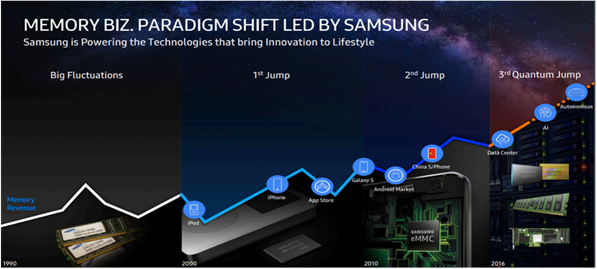
The graphic illustration above relates to Moore’s Law observing that:
“The number of transistors on a microchip doubles about every two years.” The law claims that we can expect the speed and capability of our computers to increase every two years and because of this, we will pay less for them. Another tenet of Moore's Law asserts that this growth is exponential.
More about Moore’s Law later.
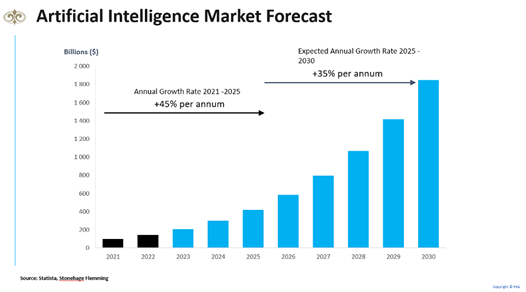
According to Statista, the artificial intelligence market is expected to grow by 45% per annum from 2021 to 2025, then slowing to 35% per annum from 2025 to 2030. See the graph below:
When looking at the interest in AI from a consumer perspective we can also see that the above expectations are not entirely unrealistic. It took apps like Facebook, Twitter, Snapchat, and Instagram more than two years to pass the 100 million subscriber mark. ChatGPT merely took two months to attract over a 100 million subscribers according to periscope global. There is also lot of interest in companies linked to artificial intelligence from a financial market perspective. From 1 January 2023 to the end of July, the S&P 500 rose by just over 20%. The share prices of the ‘Magnificent Seven’ (Tesla, Nvidia, Microsoft, Amazon, Alphabet, Apple, and Meta), as a group, jumped by almost 100% over the same period.
This leaves us with the question: Where do we see opportunities?
The table below shows the areas where we see opportunities. We have classified these ideas as follows:
1. Infrastructure – these are companies involved in physically manufacturing microchips. Both Lam Research and ASML produce equipment used in the manufacturing process.
2. Cloud services – most of the information generated must be stored somewhere daily for artificial intelligence to interpret and learn from. Microsoft, Alphabet and Amazon are the largest cloud infrastructure service providers globally.
3. Software – these include ideas we encounter daily such as ChatGPT, Siro from Apple or Alexa from Amazon.

Earlier we referred to Moore’s Law and how the processing capacity of computers doubles every two years. The concept seems absurd and even difficult to comprehend. The following story not only simplifies the concept, but it also gives us perspective of the magnitude of the growth opportunity that still lies ahead.
Once upon a time, there was a king who loved playing games. He challenged his kingdom on a daily basis to visit his palace and present a new game to him. One day, an entrepreneur paid the king a visit and taught him how to play chess. Extremely impressed with the game, the king told the entrepreneur: “No price is too high, so make your price and we will make sure that you are rewarded.”
The entrepreneur indicated that his wish was relatively simple: “The only compensation I seek is for you to put a single grain of rice on the first square of the chessboard. Then double it next week putting two grains on the second square, repeating the doubling process until the entire chessboard is covered.”
The king was delighted and instructed the kingdom’s treasury to pay the entrepreneur every week, doubling the number of grains paid in the previous week.
A year went by, and a very worried Chief of Treasury rushed to the palace and explained to the king that the kingdom could run out of rice within weeks if they continued to pay the entrepreneur. The king, confused and angry, demanded to see the entrepreneur immediately.
The entrepreneur arrived with a big smile on his face and explained matters to the king. The entrepreneur also reminded the king that the payments have not even reached the halfway mark on the chessboard.
The same applies to computer technology. In 1959, we started at the first square on the chessboard. It took us four years to move to the second square, thus doubling the amount of computing power. In 2007, we reached the 30th square with computing power 550 million times more powerful than in 1959. In 2022, we officially reached the second half of the chessboard. It is said that in 2057, when most of the millennial generation will be older than 70, we will reach the 60th square, with computer processing capacity being 575 quadrillion times more powerful in comparison with 1959.
We are looking forward to not only watching this opportunity from the sideline, but also participating in this exponential growth opportunity.