
14
August 2024
Managing risk for shifting probabilities - Angles & Perspectives Q2 2024

Lyle Sankar, Chief Executive Officer
PSG Asset Management

We believe it is possible to make significantly better decisions when we focus on the probabilities of various scenarios, rather than trying to predict exact outcomes.
By encouraging independent thinking when analysing market opportunities in the global context, our proven 3M investment process helps us to achieve better client outcomes in the long run. The case studies below provide practical insights into our thinking and decision-making process in the 'year of elections'.
There are dangers in blindly aligning to the consensus view
We typically search for opportunities in uncrowded areas of the market, where the likelihood of a market mispricing – and ensuring the odds of securing a positive outcome – is higher. Conversely, we believe a significant value-add of this process is being able to consistently avoid potential investment pitfalls.
These are areas characterised by strongly held consensus views and rich valuations that are vulnerable to unfavourable outcomes if these expectations prove to be incorrect. Often, the consensus only needs to be partially incorrect for clients to face significant downside risk.
Our 3M process helps us to decide when to be offensively positioned, and importantly, when to be more defensive in our positioning. Over the long term, this approach has helped us to avoid many of the pitfalls that markets inevitably deliver, and has enabled our funds to generate attractive yields for clients (beating inflation and cash).
Case study: SA elections and managing event riskThe recent SA elections presented a major event risk for clients and in many ways proved to be a pivotal moment for South Africa’s economic outlook. While the relief was palpable post the election, it is important to learn from these events. From our perspective:
We aimed to understand the risks associated with a poor (market-unfriendly) outcome, and considered the potential losses that could result. We believed, given we couldn’t dismiss the possibility of a negative outcome, and given what was priced into markets, it was appropriate to manage risk within our funds carefully by including additional protection ahead of the elections. We believe this approach served our clients well. Not only did our clients fare well given the ultimate outcome, but if a negative scenario had materialised, they would have enjoyed a significant degree of protection. |
Applying these learnings in global fixed income markets
When looking abroad, we see a strongly held consensus view on the future path of inflation that can benefit from closer scrutiny. US inflation is considered by most market participants to be well contained, as evidenced by 1-year inflation swaps pricing in inflation below 2% over the next 12 months, and with the market pricing with 100% certainty that the rate-cutting cycle will commence in September 2024.
With US growth beginning to slow, the market expects three interest rate cuts over the next six months, and US bonds are already pricing in a softer inflation and growth backdrop. However, we have several concerns with this consensus thesis.
We would caution against assuming inflation is destined to fall from current levels of around 3.5% to safely within the 2% target range for an extended period. In our view, the impact of longer-term inflation dynamics and drivers of inflation is being underestimated by the market, even if the economy seems to be cooling in the short term.
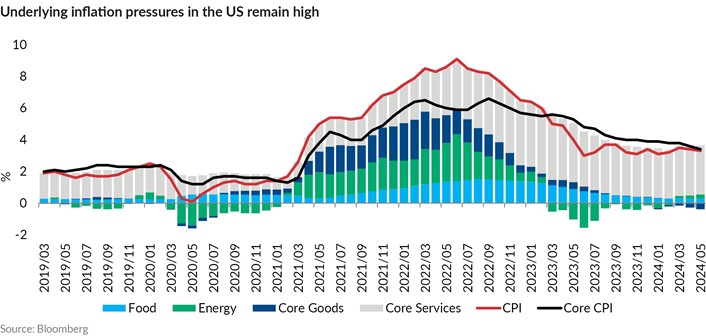
US inflation has averaged between 3% and 4% over the past year and a half, underpinned by sticky core services inflation (the grey bars in the graph above). This is primarily driven by wages, which remain elevated above the 3% level compared to the Federal Reserve’s 2% target. Wage inflation is usually challenging to bring under control without a drastic increase in unemployment.
Typically, after periods of very sticky inflation, it takes a long time for inflation to narrow to target. As a result, we believe inflation is likely to remain elevated and more volatile over the near term, contrary to market expectations.
US elections are likely to drive further inflationary pressures
US election outcomes need to be considered when trying to understand the likely direction of underlying inflation pressures in the US. However, it is likely that regardless of the outcome (Democrat or Republican), the US will continue to drive inflationary pressures through deficit spending at a time when the US has the tightest labour market in history, and wage pressures are still prevalent.
Until recently, Donald Trump was firmly in the lead as the favourite candidate in the US presidential election. The policies which he subscribes to, including a tough stance on immigration and being pro the implementation of tariffs, are likely to increase the cost of labour and the cost of goods respectively, and are therefore likely to have an impact on future inflation outcomes.
While President Biden’s decision to step down from the presidential race in favour of current Vice-President Kamala Harris has introduced more uncertainty regarding the eventual election outcomes, we know that politicians are not prone to cutting spending.
There are a number of current government policies and programmes which will be difficult to reverse, and we therefore think that government spending is likely to remain elevated, regardless of who is in the White House. Thus, we believe the current consensus view of low inflation is at a considerable risk of not coming to fruition.
We see a high likelihood of policy error, with implications for investor returns down the line
The market is currently pricing in three interest rate cuts in 2024, and we expect that the Fed will cut rates even though we do not think inflation is under control (as outlined above). This seems to have become something of a foregone conclusion, following on the recent spate of concerning economic data releases we have seen.
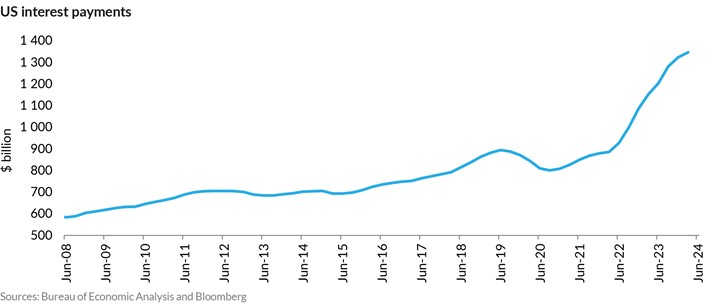
One of the reasons we expect the Fed to cut is that they are acutely aware of the impact of elevated interest rates on the US debt burden, on debt servicing costs, and on the amount of debt that the US treasury needs to issue to market. The US continues to spend significantly more than it earns, and its interest payment bill has ballooned by more than 75% over two years.
We estimate that in the next three years, the US will issue in excess of $20 trillion of debt to refinance maturing bonds and sustain current budget deficits. While it is not their primary mandate, one way to control this dynamic is to lower the cost of debt.
However, cutting rates without inflation being under control has negative implications for the currency, for the attractiveness of their debt instruments, and also impacts how the interest rate cycle progresses from this point forward.
Larger cycles drive relative price moves in markets and although the US dollar has been on a 15-year upward cycle, there is a distinct possibility that the US dollar will weaken from here, marking an inflection in the current cycle. These are typically attractive environments for emerging market assets, including South Africa.
We believe the local market offers investors attractive opportunities
Shifting the focus to SA, we believe there is reason for continued positive sentiment. We highlight some aspects which need to be considered when setting exposure to SA assets. We believe the environment has grown increasingly favourable for local assets to outperform:
- No load shedding for close to three months, with energy supply outstripping demand.
- The anticipated rate cutting cycle could be deeper than many would have expected.
- Greater political certainty and forward momentum on the much-needed reform agenda.
- A tailwind for emerging markets through an inflection in market cycles (a weaker US dollar environment).
We believe for bond investors, the probability has shifted towards the bull case of equity-like returns at bond-like levels of risk.
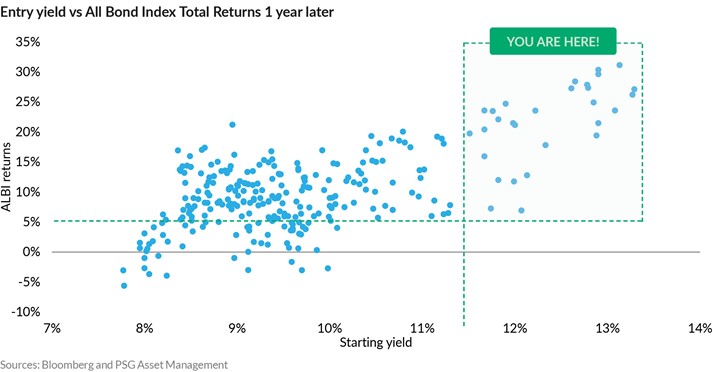
Avoiding the ‘speed bumps’ has rewarded our investors
We believe that thinking in probabilities has enabled us to avoid many of the pitfalls we have seen in fixed income markets to date, while our approach of finding opportunities in overlooked areas in the market has enabled us to provide long-term investment excellence to our clients. Importantly, we always keep our eyes fixed on the objective of capital preservation, which should also be a top priority for fixed income investors, in our view.
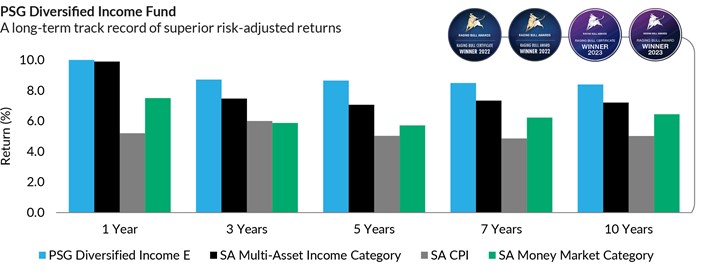
Source: Morningstar, 30 June 2024. The PSG Diversified Income Fund won the trophy for Best South African Interest-Bearing Fund and certificate for Best South African Multi-Asset Income Fund (over varying periods) in both 2022 and 2023 at the Raging Bull Awards.
Looking forward, we believe local investors currently have the opportunity to lock in attractive real yields in South African bonds at the peak of the interest rate cycle. However, this window of opportunity will not last indefinitely, and thus we are actively positioning our funds to make the most of the prevailing dynamics in the market, to our clients’ advantage.

PSG Asset Management (Pty) Ltd is an authorised financial services provider (FSP 29524). More information on all funds administered on the PSG Collective Investment (RF) scheme and more information on the Raging Bull Awards can be obtained from PSG Collective Investments (RF) Limited, at PSG Asset Management.