



At PSG Asset Management, our 3M investment process often leads us to search for opportunities in overlooked and unloved areas of the market. Finding assets with some unappreciated quality at low prices is the foundation for our portfolios. In late 2025, that was a good description of the energy sector. In this article, we explain our differentiated viewpoint as to why oil supply is likely to be lower than anticipated in the years to come. Given the current Iran conflict, this may seem like a moot point, but in 2025 the overwhelming consensus was that we were more likely to see an extended oil glut. We also discuss an alternative way to think about the volatility and timing of returns from the energy sector, highlighting the risk mitigation role these counters play in our portfolios.
The first oil crisis and the birth of the International Energy Agency (IEA)
In late 1973 and 1974, the world endured a severe oil crisis. Following the Yom Kippur War, Arab oil exporters embargoed countries they believed were helping Israel. In the US, oil demand growth was outstripping domestic production, with crude imports rising from 1.3 million barrels per day (bpd) in 1970 to 3.7 million bpd on the eve of the crisis in 1973. As the embargo took effect between July 1973 and October 1974, the price of West Texas Intermediate (WTI) more than tripled from $3.56 to $11.16 per barrel. A global growth slowdown ensued, with the US enduring its worst recession since the Great Depression of the 1930s.
In response, the US and 16 other countries from the Organisation for Economic Co-operation and Development (OECD) formed the IEA. The IEA’s mandate was to maintain emergency oil reserves and enable a coordinated response to oil supply shocks. The goal was to ensure affordable and reliable energy. They would also provide transparency through data on the global oil market, and annually publish the World Energy Outlook as a key data source for decision-makers in government and industry.
The IEA becomes political
Dr Fatih Birol has been the Executive Director of the IEA since 2015. In November 2017, the IEA launched the Clean Energy Transitions Programme (CETP). Funding for this was by voluntary donations from member governments and has grown to between 25% and 30% of the IEA’s total budget. Under Dr Birol, the IEA started showing signs of methodological bias. Its baseline scenarios incorporated in the World Energy Outlook consistently projected much weaker oil demand than what was subsequently recorded. Projections of ‘peak’ demand have also proved incorrect.
“No new investment is needed”
In their 2021 report Net Zero by 2050: A Roadmap for the Global Energy Sector the IEA, an agency created to ensure energy supply security, came to an astounding conclusion: “There is no need for investment in new fossil fuel supply projects in our net zero pathway.” By 2024, the World Energy Outlook simply ignored current demand trends and based forecasts on assumptions that all nations would successfully achieve their energy transition goals. The key reference data used to guide decisions by policymakers, industry and investors was presented in such a biased fashion that it raised the risk of severe underinvestment and future shortages. It appeared that the IEA had effectively become renewable energy activists working against the oil industry and neglecting the crucial ‘affordable and reliable’ part of their energy mandate.
The IEA backtracks
In the 2025 World Energy Outlook the IEA reinstated the use of a Current Policy Scenario (CPS), which provides a more realistic baseline for its projections (reference 3). It shows no peak in oil demand, as far out as 2050. Why the change of heart? Importantly, the IEA had also updated its work on depletion rates, publishing The Implications of Oil and Gas Field Decline Rates in September 2025 (reference 1). This excellent piece of research highlighted how the natural decline rates of existing oil and gas fields had increased. The Natural Decline Rate is the speed at which production slows if no new capital investment is made in existing fields. The IEA estimated for 2024 a natural decline rate of 8% per annum for oil and 9% per annum for gas.
“Our analysis shows that accelerating decline rates, increased reliance on unconventional resources, and shifts in project development patterns are reshaping the oil and gas supply landscape. These trends indicate that efforts to sustain global production at current levels will require ongoing, targeted investment mainly to maintain existing assets, but also to develop new projects to meet demand…”
So, the IEA has changed its position to one that views new investments in fossil fuels as very clearly necessary.
Why have depletion rates increased?
Conventional oil fields have dropped from 97% of production in 2000 to 77% in 2024 (conventional gas is 70%). The proportion of oil and gas coming from unconventional sources, primarily ‘tight’ oil and gas from shale, greatly increases the decline rates, as it is much more difficult to extract. The IEA estimates the natural depletion rate of today’s aggregate tight oil and gas fields to be a huge 30% in the next 12 months and 15% in the following year.
In our opinion, no analysis of the oil and gas supply outlook is complete without a detailed consideration of the impact of high depletion rates, yet this topic tends to be largely ignored. In late 2025, the consensus view was that we would see many years of surplus production, yet the potential rate of depletion, its impact on required capex and subsequent oil supply were hardly covered.
ExxonMobil, experts in tight oil extraction, believe that, going forward, depletion rates will be much faster than historical rates modelled by the IEA. ExxonMobil’s Global Outlook: Our view to 2050, published in 2024, says the following:
“Our outlook reflects oil production naturally declining at a rate of about 15% per year. That’s nearly double the IEA’s prior estimates of about 8%. This increase is the result of the world’s shifting energy mix toward ‘unconventional’ sources of oil and natural gas. These are mostly shale and dense rock formations where oil and gas production typically declines faster.
To put it in concrete terms: With no new investment, global oil supplies would fall by more than 15 million barrels per day in the first year alone. At that rate, by 2030, oil supplies would fall from 100 million barrels per day to less than 30 million – that’s 70 million barrels short of what’s needed to meet demand every day.”
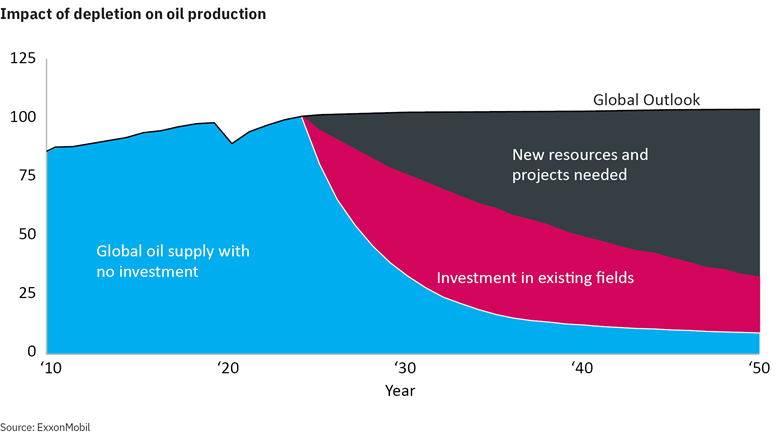
Current oil production scenarios may be overly optimistic
The IEA’s backward-looking natural depletion estimate for oil of 8% as at 2024 appears conservative relative to ExxonMobil’s forward-looking 15% rate. Whatever the exact rate will be, we do know that high depletion rates require very large amounts of capex to just maintain production. In other words, the world’s energy producers have to “run faster and faster just to stand still”. Current research estimates of future oil and gas supply frequently do not address depletion rate assumptions. The probability that future oil supply is substantially over-estimated, is significant.
The role of energy stocks in our portfolios
We believe it is important to know what the role is of every asset that is held in a portfolio. As discussed, we hold the view that insufficient investment is being made in the energy sector once the impact of high depletion rates is factored in. This implies higher oil prices and good earnings delivery by the energy stocks over the long term, making them attractive holdings based on their fundamentals.
As a cyclical sector with hard-to-forecast earnings and high price volatility, conventional wisdom is that energy stocks are risky. We would disagree with this view, and have long recognised that energy stocks play an important safe-haven role in our portfolios. Their volatility of return is of much less importance than when they deliver above-market gains. Returns delivered in environments where many other sectors and asset classes are struggling are especially valuable.
Two relevant quotes from a few years ago:
Assessing risk in the energy sector, PSG Angles & Perspectives, First Quarter 2024:
“… where the primary fear relates to inflation and constraints on policymakers’ responses, as it did in 2022, the energy sector can take on the role of a safe-haven asset and deliver dramatic outperformance and positive nominal returns. In addition, if investors become nervous about geopolitical risks, energy can once again act as a portfolio safe haven.
This characteristic of the energy sector has effectively lain dormant over the decade of secular stagnation and low macro and geopolitical turmoil prior to 2021/22. This means this environment does not appear in the typical quantitative risk model’s look-back period, and hence the inflation and geopolitical safe-haven character is unappreciated by most risk systems.”
Rethinking ‘safe haven’ assets, PSG Angles & Perspectives, Third Quarter 2023:
“Finally, the energy and gold sectors have embedded optionality to the price spikes that typify geopolitical upheavals. Recent events have been a sombre reminder of how important this may be for portfolios in the future.”
In the first quarter of 2026, our funds’ energy stocks performed their role: they provided excellent absolute returns at a particularly difficult time in markets and hence were also very effective risk mitigators for our portfolios.
Further reading (references):
(1) The Implications of Oil and Gas Field Decline Rates, International Energy Agency, 2025
(2) ExxonMobil Global Outlook: Our view to 2050, 2024
(3) The Return of Realism in Global Oil Forecasts: A Critique of the International Energy Agency’s World Energy Outlook 2025, National Center for Energy Analytics, January 2026