30
July 2026
Look before you leap: seeking alternatives to getting caught in the AI capex boom

Dirk Jooste
Fund Manager,PSG Asset Management

In all the excitement about artificial intelligence’s (AI’s) transformative potential for our economies and the resultant efficiency gains, it is easy to forget that a business case is not necessarily the same thing as an investment case.
While technologies can and do transform societies in deep and fundamental ways, it is less clear who benefits from the technology race. Frequently, it is society at large ̶ rather than the companies that dominate headlines ̶ that are the primary winners in the long run.
Technology races are frequently accompanied by capital expenditure (capex) booms, as millions are poured into building the infrastructure that is needed to exploit the new technology. Markets tend to buy into these narratives, driving more excitement that leads to more investment, and so the cycle reinforces itself. However, as with any overcrowded market, at some point, market dynamics reassert themselves. And the unwinding of these bubbles can frequently be painful. Examples include US railroads in the 1880s and telecoms during the dotcom bubble. (Read more about our thinking on this subject here).
Who wins in a capex boom?
Builders and investors typically lose ̶ society benefits
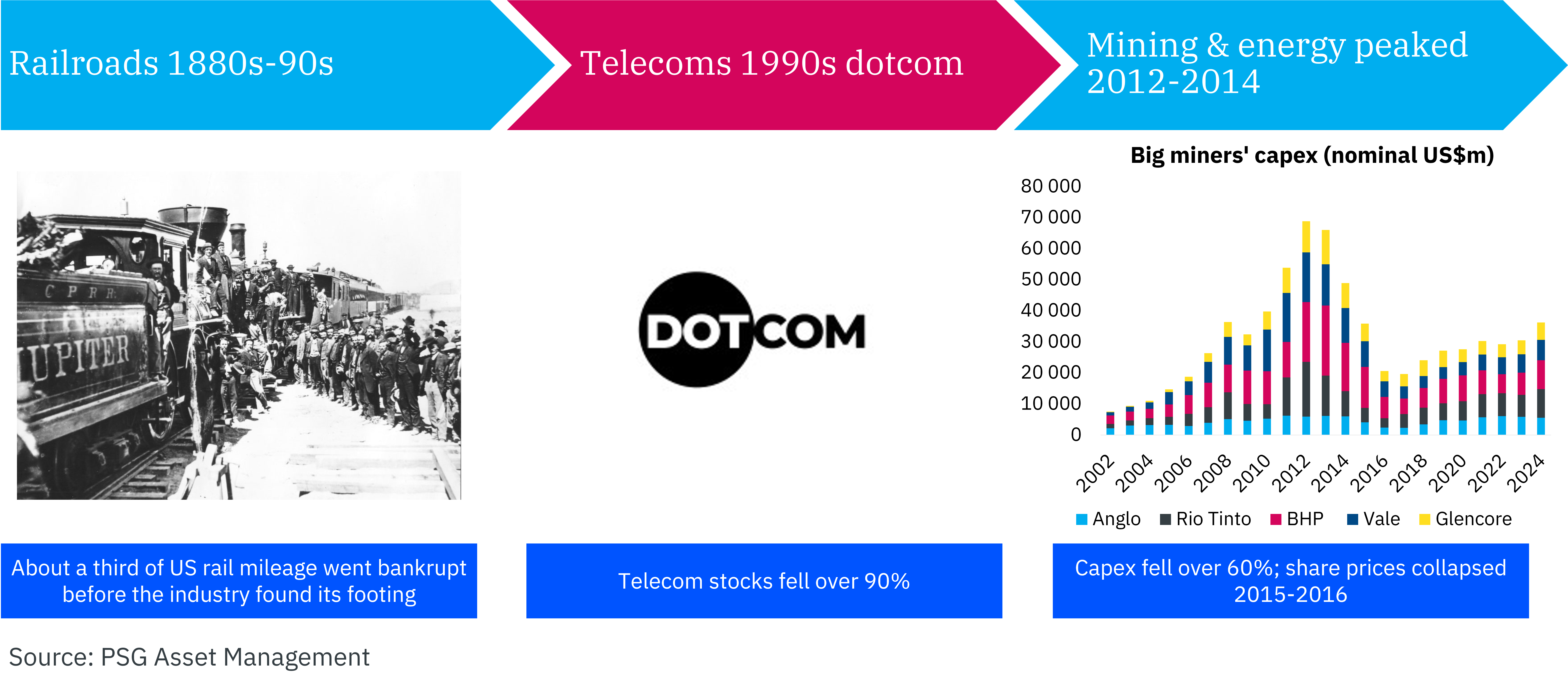
The AI chapter is still being written
Like other transformative technologies, AI is drawing high levels of investment. What seems to be different this time, is a high level of interconnectedness between hyperscalers and the chip companies who are simultaneously each other’s suppliers, customers and investors. In addition, the CEOs of these companies are facing something of a prisoner’s dilemma. Not following the crowd or opting to scale back in the AI arms race is sure to result in instant irrelevance and a painful market penalty, as it could be interpreted as admitting defeat in what has morphed into an existential AI competition. As long as the proverbial music keeps playing, they are sure to continue dancing, even if there are doubts about the sustainability (or profitability) of the current AI build-out.
The post-GFC environment contributed to distorted capex spend
The period following on the Global Financial Crisis (GFC) saw a low return, low interest rate environment that benefited long-duration assets (with low free cash flow yields, like technology stocks), and rewarded investors in these sectors, creating more excitement and driving continued investment. The giant leaps in AI technology over the past few years have sparked fever-pitch excitement. We also saw an intense focus on environmental, social and governance (ESG) factors, which resulted in some sectors being starved of capital, even though we are likely to remain dependent on them for some time to come. The result has been profound underinvestment in many real-world assets and sectors, like energy, even as we saw more investment flowing into mega-cap technology stocks and AI specifically.
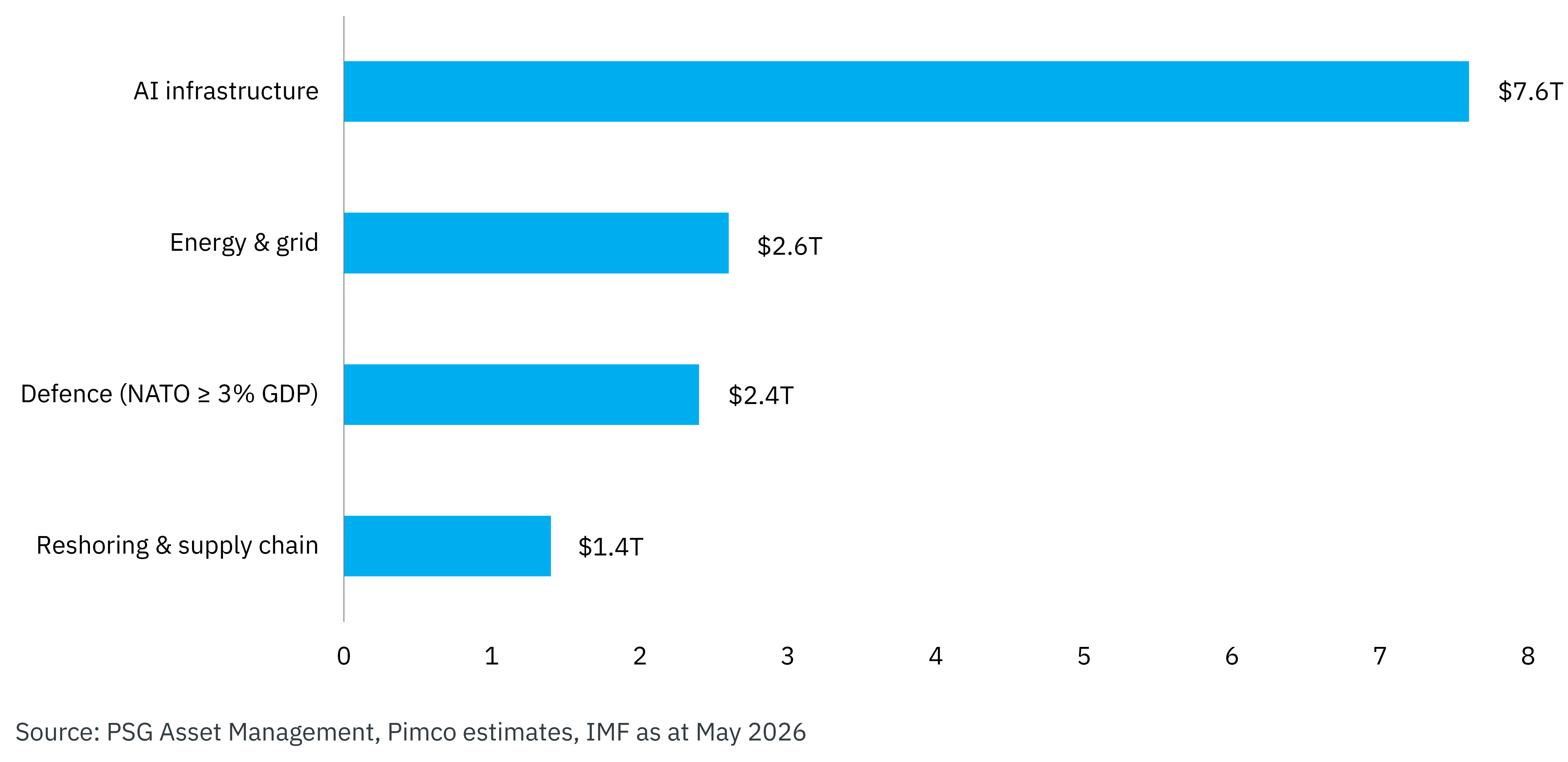
Currently, AI infrastructure accounts for more than half of global capex spend over the next five years, or US$7.6 trillion of the expected US$14 trillion global capex investment pool. Given such a crowded position, we have to ask if all investors are likely to be rewarded, even if the technology itself has enormous transformative power for society more broadly. With the companies themselves priced for perfection, even small disappointments have the potential to translate into market repricings and investor pain.
Cumulative incremental capex 2026-2030, USD trillions
Alternatives to getting caught up in the AI capex boom (and bust)
We want to be careful about where in this capex boom we invest – not because the benefits of AI are not real, but because history has shown time and again that capex cycles can be brutal if you’re caught on the wrong side. Therefore, we are looking to underappreciated areas of the market to find mispriced, quality assets that pass our 3M investment process.
While the trade in AI infrastructure may be crowded and hyped, many companies in support industries are set to benefit from the AI build-out indirectly, and continue to trade at very attractive valuations. We have found investment in energy supply companies an especially attractive prospect.
In addition, a more fragmented and contested world will require a multi-year build-out of supply chains and energy security. These are precisely the physical, real-asset sectors that were overlooked in the post-GFC era. Crucially, this global capex surge requires enormous upfront financing, placing structural upward pressure on global yield curves as corporate and sovereign debt markets absorb unprecedented issuance. In an environment where elevated capital costs and rising term premia pose severe valuation risks to overpriced US equities and long-dated growth plays, we explicitly prefer the short-duration profile of high free-cash-flow yield businesses that generate immediate cash flow today.
Beyond dedicated energy holdings, we are finding exceptional value across select developed and emerging markets, from value-rich European and UK counters to Brazil and our domestic exchange. Here, both primary energy producers and diversified commodity miners face structural supply constraints following a decade of underinvestment. Alongside deeply discounted industrial and financial businesses, these real-asset plays stand as prime beneficiaries of this physical global build-out at low valuations, offering a compelling margin of safety relative to expensive US alternatives.
Capex cycles are unforgiving, and avoiding overpriced assets is key
Market history has shown time and again that capex cycles can be unforgiving. However, a disciplined review of the market environment reveals that there are still many opportunities available to investors, often outside the most popular and crowded trades. A price-sensitive, bottom-up stock picker like PSG Asset Management is well positioned to help investors navigate a complex and an evolving investment landscape and unlock value, while avoiding over-allocation to expensive assets that are already priced for perfection.
Dirk Jooste is a Fund Manager at PSG Asset Management.